
By Naim Reza
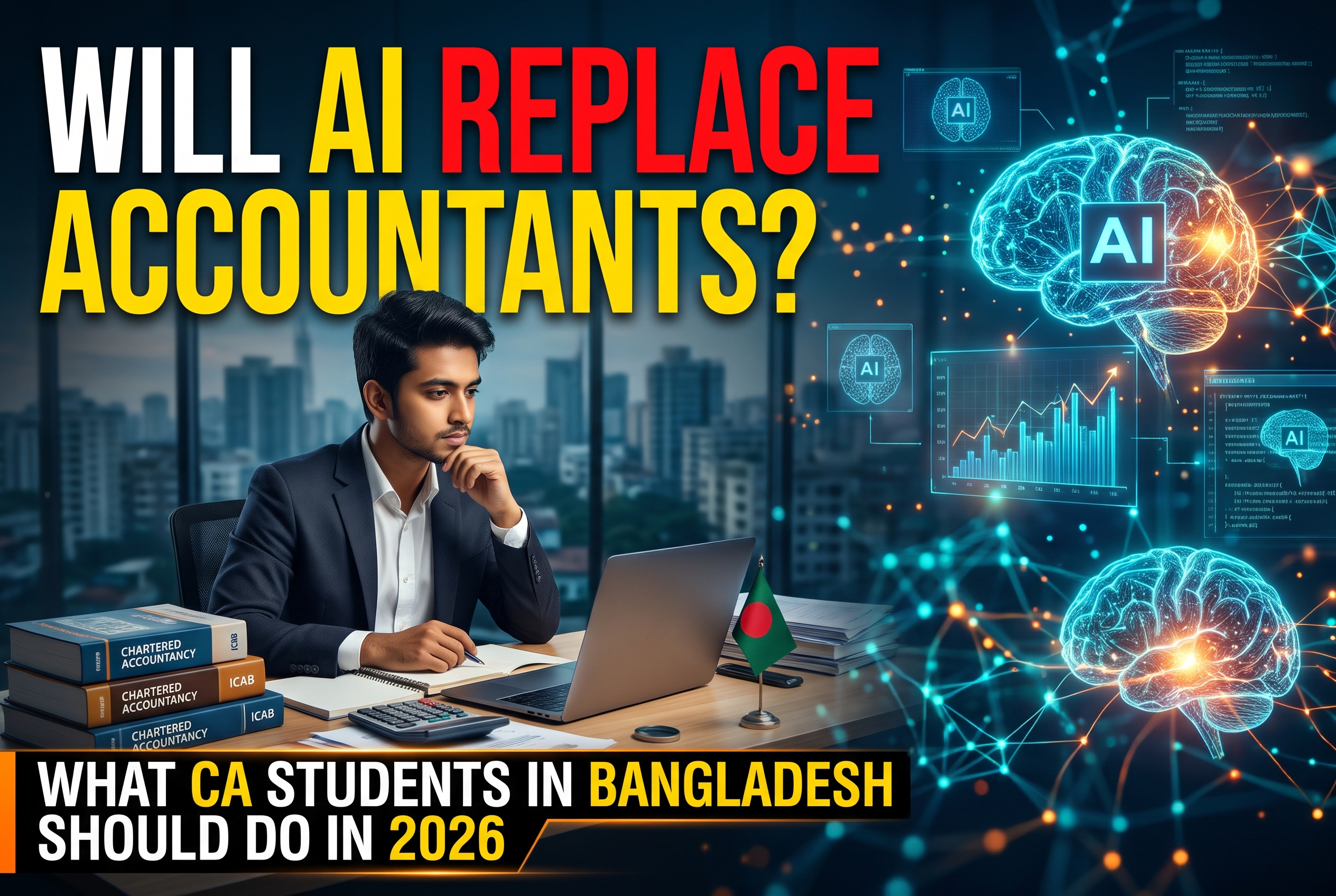
If you are studying for your Chartered Accountancy, you have probably asked yourself one question this year: will AI replace accountants? It is a fair worry. Every few weeks a new tool promises to reconcile accounts, draft working papers and flag risky transactions in minutes. But the real picture in 2026 is more interesting than a simple yes or no. AI is not removing the accountant. It is changing what the accountant spends their day doing, and that change matters a lot for anyone starting their articleship today.
The short answer
No, AI is not going to replace accountants and auditors, but accountants who use AI well will replace those who do not. Routine work such as data entry, reconciliations, journal matching and first pass testing is moving to software. Judgement, professional scepticism, ethics and the ability to explain a conclusion to a client are staying with people. Industry commentators in 2026 keep returning to the same idea: AI takes the repetitive work, and humans provide the context and accountability that a machine cannot.
What is actually changing in accounting and audit
The biggest shift is the move from tools that wait for you to tools that act on their own. Thomson Reuters describes 2026 as the year of agentic AI in audit, where software can support planning, risk assessment, evidence collection and review across the whole engagement. Alongside that comes continuous assurance, which means testing data throughout the year instead of piling everything into year end.
This creates a new kind of risk. Grant Thornton points out that in accounting the risk moves from manual mistakes to system design and data quality, while in audit it moves toward relying on models and being able to challenge what a system produces. In plain words, it is no longer enough to accept an output because the software gave it. You must understand how it was produced and be willing to question it.
Firms are also asking whether they are ready. A BDO survey of finance leaders found strong interest in continuous auditing, but they named better internal data infrastructure and stronger AI governance as the main things standing in the way. So the opportunity is real, but so is the gap between interest and readiness.
Where Bangladesh and ICAB stand
This conversation is very much alive in Bangladesh. At the 22nd convocation of the Institute of Chartered Accountants of Bangladesh in April 2026, the chief guest urged newly qualified chartered accountants to prepare for the challenges of artificial intelligence and not rely on institutional knowledge alone. Earlier in the year, ICAB hosted the SAFA International Conference in Dhaka under the theme of converging ethical AI and sustainability reporting.
ICAB leadership has also been honest about where we are. The president acknowledged that Bangladesh is behind countries such as India when it comes to AI driven audit and automation tools, while saying that AI and ESG are being added to training programmes and that the syllabus is being updated in line with international standards. ICAB also held a workshop on its Revised Syllabus 2025 in June 2026 to prepare the next generation of chartered accountants.
For a student, the message is clear. The profession knows the change is coming, the institute is adjusting, and the people who get ahead will be those who start building skills before they are formally required.
Skills CA students should build now
You do not need to become a programmer. You do need to become comfortable with technology and sharper in the areas AI cannot cover. Here is where I would focus.
Strong fundamentals. AI can only be challenged by someone who understands the standards underneath. Do not skip the basics of IFRS, ISA, taxation and law because a tool seems to know them. You cannot review what you do not understand.
Data and spreadsheet confidence. Learn to clean, sort and question data. Advanced Excel or Google Sheets, pivot tables and basic data analysis are now part of everyday audit work. Even a little scripting knowledge helps you understand what automation is doing.
Working with AI responsibly. Practise using AI tools for research, summaries and drafting, and always verify the result against the source. Learn the limits around client confidentiality and never paste sensitive client data into a tool without approval from your firm.
Professional scepticism and ethics. As more work becomes automated, the human role becomes more about judgement. Your ability to ask the uncomfortable question is going to be your biggest strength.
Communication. Clients do not want a printout from an algorithm. They want someone who can explain what the numbers mean and what to do next.
Awareness of ESG and sustainability reporting. This is a growing area of work and one that ICAB is clearly paying attention to.
A simple way to start this month
Pick one repetitive task from your daily articleship routine and ask how it could be done faster with a spreadsheet formula, a template or an approved AI tool. Then write down what you would still need to check manually. That small habit teaches you both sides of the story: what can be automated and what still needs a human eye. Do it a few times and you will start to see where your own value sits.
Frequently asked questions
Will AI replace accountants in Bangladesh? Not in the foreseeable future. Adoption in Bangladesh is still behind some neighbouring countries, and the profession depends heavily on judgement, regulation and client trust. Roles will change, however, and basic task work will shrink first.
Is CA still a good career with AI growing? Yes. Chartered accountancy is still seen as a respected qualification, and ICAB is updating its syllabus to include AI and ESG. A CA who understands technology is likely to be more valuable, not less.
What skills should an articled student learn for the AI era? Strong technical fundamentals, data analysis, spreadsheet skills, responsible use of AI tools, professional scepticism and clear communication.
Which accounting tasks will AI automate first? Data entry, reconciliations, journal matching, document review and routine testing are the first to move, because they follow clear patterns.
Final thoughts
The question is no longer whether AI will touch accounting and audit. It already has. The better question is how you want to show up in a profession where the routine work is handled by software and the valuable work is judgement, trust and clear thinking. If you build strong fundamentals, stay curious about technology and keep your ethics sharp, you will not be competing with AI. You will be the person who knows how to use it properly.
I am an articled student at Mahfel Huq & Co. with a background in Accounting and Information Systems and a practical interest in building things with WordPress, so I find this crossover between accounting and technology genuinely exciting. If you would like to talk about it, feel free to get in touch through my contact page, or read more about my CA journey and my digital projects.
Sources and further reading: Thomson Reuters Tax and Accounting on audit challenges in 2026, Grant Thornton on AI in financial reporting and audit risk, BDO research on AI and continuous auditing, ICAB news and the Financial Express coverage of ICAB’s reform plans, and BSS coverage of the 22nd ICAB convocation.